When I first heard that Grand Staircase–Escalante National Monument was home to two slot canyons with names like Peek-a-Boo and Spooky, I knew I had to experience them for myself.
It quickly became one of the most unique hikes I’ve ever done in Grand Staircase–Escalante — and honestly, one of the most memorable hikes anywhere.
Not because of the distance.
Not because of the views.
But because of the experience of squeezing through narrow canyon passages, finding your way through tight sections, and constantly figuring out how to navigate the terrain ahead.
Some sections are challenging. Some require careful movement. And that’s exactly what makes this hike so unforgettable.
Getting There
Peek-a-Boo and Spooky Slot Canyons are accessed via Hole-in-the-Rock Road, a remote dirt road that branches off Scenic Byway 12 inside Grand Staircase–Escalante National Monument.
The drive takes you about 26 miles along Hole-in-the-Rock Road to the Dry Fork turnoff, which leads to the trailhead parking area.
The drive itself is part of the adventure. It’s long, rugged, and features some of the roughest washboard road conditions I’ve encountered.
From the parking area, the hike begins by crossing open desert terrain before descending into Dry Fork Wash, which eventually leads to the slot canyons.
Dry Fork Wash leading toward Peek-a-Boo in Grand Staircase–Escalante National Monument
The route connects Peek-a-Boo and Spooky Gulch as a loop, but don’t expect a clearly marked trail the entire way. Instead, you’ll follow the natural contours of the canyon, read the landscape, and make route decisions as you go.
That sense of exploration is a big part of what makes this hike so special.
The Route
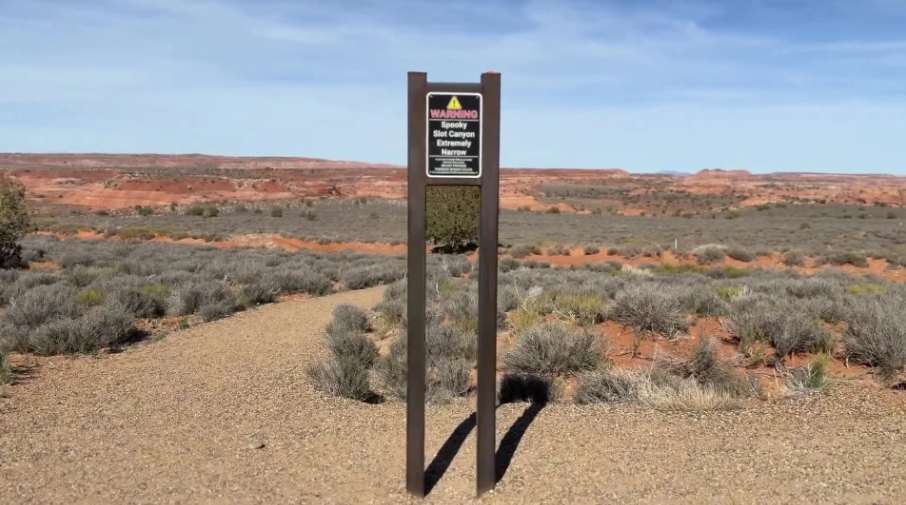
You’ll want to park at the Upper Dry Fork Trailhead (North Trailhead). The parking area has a restroom, along with a metal frame you can walk through to get a sense of whether you’ll fit through the narrow sections of the slot canyon.
And trust me — it’s tight. In some places, it’s even narrower than that frame.
From the parking lot, you’ll cross Hole-in-the-Rock Road and begin the hike across the open desert.
Early on, you’ll come to a fork in the trail. Stay straight — don’t go right. You’ll know you’re heading the right way when you pass through a small zig-zag style gate.
From there, the route continues across open terrain before descending into Dry Fork Narrows, where the landscape begins to change and you start to feel like you’re entering a true slot canyon.
Eventually, you’ll emerge back into open desert, and this is where the route can become a little confusing. The entrances to Peek-a-Boo and Spooky are just around the corner from here.
Getting Into Peek-a-Boo
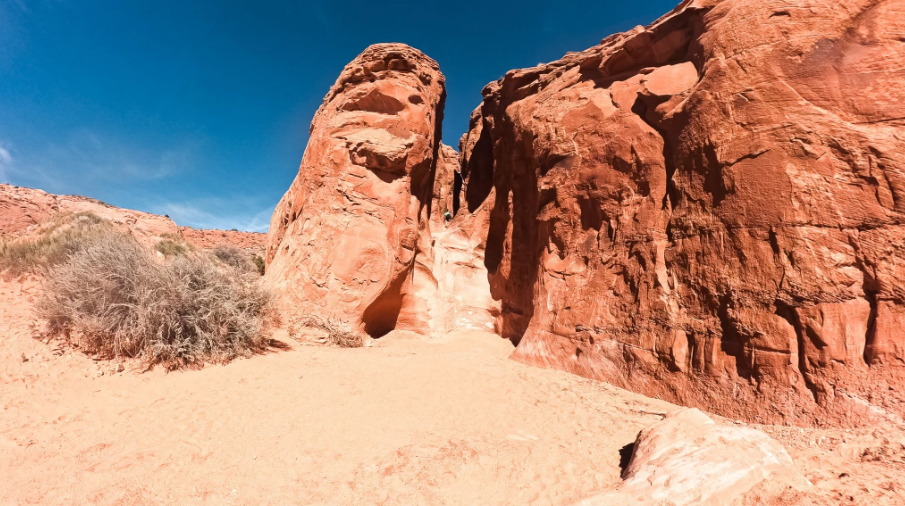
Peek-a-Boo entrance — steeper than it looks
The climb into Peek-a-Boo
This is the section that surprises a lot of people.
You don’t simply walk into Peek-a-Boo.
You have to climb your way up and into it.
The climb isn’t long, but it does require using your hands and carefully watching your footing. From below, it’s one of those moments where you stop and think, “How exactly am I supposed to get in there?”
To be honest, I wouldn’t have made it up without some help from a couple hiking behind me — they gave me a boost. There aren’t many reliable footholds or handholds, which makes the entrance more challenging than it appears from the bottom.
And once you’re inside Peek-a-Boo, there’s another similar section shortly afterward that requires the same kind of careful movement.
Inside Peek-a-Boo
As you move deeper into Peek-a-Boo, the canyon walls begin to close in. The light changes, shadows move across the sandstone, and you find yourself surrounded by smooth curves and shapes that feel sculpted rather than simply formed.
You’ll step over rocks, squeeze through narrow passages, and constantly adjust the way you move through the canyon.
It’s not necessarily difficult, but it keeps you focused from beginning to end.
Between Peek-a-Boo and Spooky
After leaving Peek-a-Boo, you return to open trail again, and this is where the route can feel a little uncertain.
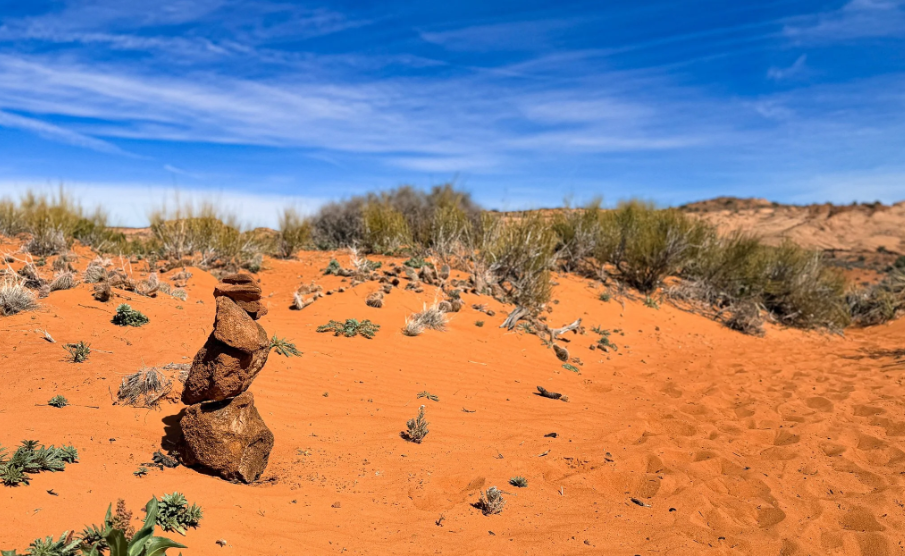
The path isn’t clearly defined the entire way. You’ll occasionally see stacked rocks (cairns) marking the route, but they aren’t always obvious or consistent enough to depend on completely.
Cairns help guide the way between Peek-a-Boo and Spooky, but the route isn’t always obvious
👉 This is where Trailforks was especially helpful for me. It helped me keep track of my location and make sure I was still heading in the right direction.
The entire 1.7-mile loop isn’t spent inside narrow canyon walls. This section opens up into desert terrain before dropping back into Spooky, creating a short stretch of open travel before you return to the slot canyon environment.
Spooky Gulch
Spooky is tighter.
Much tighter.
There are sections where you have to turn sideways to squeeze through, press your shoulders against the sandstone walls, and move forward in a way that feels completely different from a typical hike.
At one point, you’ll need to drop down and crawl beneath massive boulders. This was where I looked down and realized my key had fallen out of my pocket — which turned into a bit of a stressful moment.
It’s also the kind of section where some hikers decide they’ve had enough and turn around. A couple behind me did exactly that after seeing the narrow drop ahead.
If Peek-a-Boo is about movement, Spooky is about space — or the complete lack of it.
It’s incredibly tight, and toward the end, you might find yourself thinking:
“Is this canyon ever going to end?”
What It’s Like
This isn’t a hike where you can switch off and simply follow the trail.
You’re paying attention the entire time — where to step, how to position your body, and what obstacle is waiting around the next corner.
And that’s what makes it so unique.
The experience isn’t about reaching a destination or checking off a viewpoint.
It’s about the process itself — navigating the canyon, adapting to the terrain, and experiencing every twist and turn from start to finish.